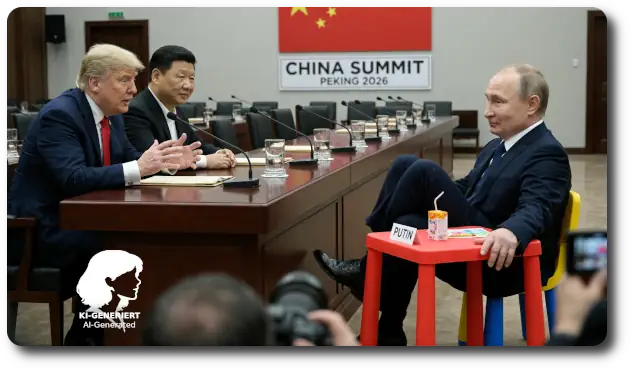
 Vladimir Putin’s appearance at the APEC summit in the Chinese metropolis of Shenzhen was a balancing act between stagecraft and protocol: Xi Jinping gave him an international platform, yet the host’s personal warmth went to someone else.
Protocol Discrepancy on the Tarmac and in the Group Photo
At the airport, Xi Jinping greeted Donald Trump with a hug—a gesture that is anything but customary in China and was extended, of all people, to the U.S. president whom Beijing otherwise portrays as a trade adversary. Putin had arrived a day earlier and was received by a senior Chinese official. Social media users quickly read symbolism into the contrast, right down to the positioning during the summit’s "family photo". Although nothing of the sort was confirmed by news agencies, the gap in protocol was unmistakable.
Propaganda Staging Around the "Cheget" Nuclear Briefcase
Russian state propaganda, meanwhile, went hunting for other highlights. In Shenzhen, Kremlin TV reporter Yevgeny Popov spotted an officer carrying a black briefcase near Putin and beamed enthusiastically during his live broadcast: the nuclear briefcase! The officer confirmed it on camera. The catch: the so-called Cheget accompanies Putin on virtually every foreign trip. It was already seen in China in 2023 and 2024, and it does not contain a nuclear launch button, but rather secure communications equipment for military command. As a superpower gesture, parading a briefcase in Shenzhen—where China showcases robotics, artificial intelligence, and advanced manufacturing—looks diminishing rather than impressive.
Economic Reality Versus Growth Rhetoric
The centerpiece of Russia’s self-portrayal became Putin’s economic pitch. Addressing executives and politicians at the APEC CEO Summit, he claimed that Russia had grown into Europe’s largest economy despite sanctions—measured in nominal GDP, that is false, with Germany well ahead, and even Putin’s own government projected growth of just 0.4 percent at points during the year. The contrast with the reality of Russia’s energy sector is striking: Ukrainian drone strikes on refineries are putting infrastructure under growing strain, while Moscow has been touting the "Power of Siberia 2" gas pipeline for years and once again failed to finalize it at this summit—not least because China, which has long kept gas prices down, scarcely needs the project economically.
Shenzhen as a Showcase of Inequality
That Shenzhen of all places served as the venue was hardly a coincidence: having grown from 400,000 to around 18 million inhabitants, the metropolis is China’s flagship example of technological ascent—robotics, unmanned systems, semiconductors. Beijing staged itself as the market of the future, whereas Moscow offered raw materials, energy corridors such as the Northern Sea Route, and the loyalty of a sanctioned partner with virtually no alternatives.
Historic Trilateral Talks and a Modest Cultural Tally
In terms of tangible outcomes, quite a bit materialized: bilateral talks with Xi, a separate meeting with Trump ahead of the historic first trilateral talks among the three nuclear powers, and finally a joint "Declaration on Peace" regarding nuclear risk reduction. Putin’s own highlights sounded far more modest: during a local university visit, he emphasized that more than 100,000 Russians are learning Chinese and over 60,000 Chinese students are enrolled in Russia, while more than 20,000 Russians study in China. Educational exchange is a worthwhile building block, yet presented as the centerpiece of a state visit, it comes across like homework handed in to Beijing instead of multi-billion-dollar deals.
Conclusion: A Partnership Without Equality
The essence of the China trip was therefore neither a humiliation nor a triumph, but a demonstration of dependencies: Russia brought energy, raw materials, and geopolitical loyalty to the table, yet little that could impress its host in terms of future-oriented technology. China needed the appearance for its own image as a global statesperson; Putin needed it as proof that his isolation is cracking. Both sides delivered—just not on equal footing.