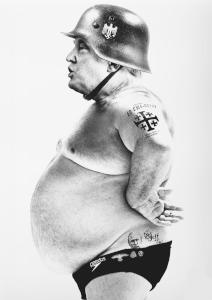
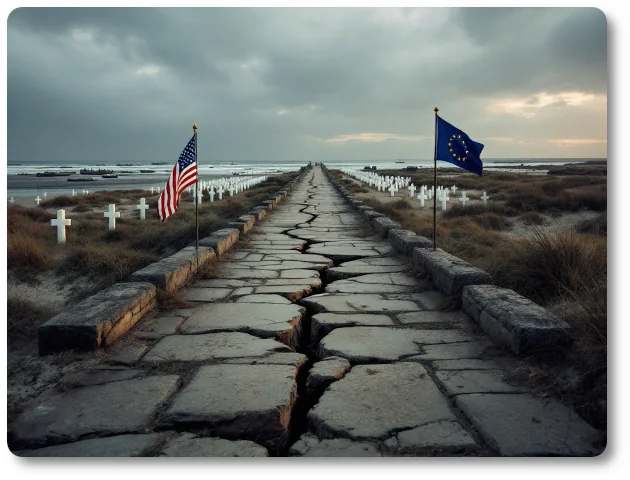
 Pete Hegseth, the United States Secretary of Defense – though he prefers to call himself the Secretary of War – flew to Normandy to attend the 82nd anniversary of the D-Day landings. He delivered a speech at the American Cemetery in Colleville-sur-Mer. According to the Pentagon, he had brought his family at his own expense and subsequently skipped the main international ceremony, which was attended by French Prime Minister Sébastien Lecornu. Four hundred international guests and representatives of the allied nations, whose soldiers landed on those beaches 82 years ago, were present. However, his absence from the ceremony was not regretted.
In the village of Langrune-sur-Mer, where the international event took place, a local civic association called L’Ancre et la Mer had already published a statement titled "Pas d’honneur" (No Honor), demanding that Hegseth's visit be completely canceled and declaring him persona non grata. Pete Hegseth, yet another living proof that a prominent jawline does not make a man, was informed by the residents of a Norman village that he was not welcome at the commemoration of their country's liberation.
When Symbolism Collides with Political Reality
And this story is not about a man's visit to a cemetery or his jawline. It is about what happens when the symbolic relationship between the United States and Europe, built on shared sacrifices, common values, and the memory of a jointly fought war, collides with today's political reality.
The country that liberated Normandy in 1944 is now withdrawing its submarines from NATO, waging an unprovoked war in the Middle East, and sending its Secretary of Defense to the exact beaches where allied troops died to grant Europeans freedom – only to give Europeans a lesson on immigration.
Hegseth's speech at the American cemetery was hardly a commemoration. It was a political address. Standing before the graves of soldiers who had fought against fascism, he compared immigration to an invasion. He stated:
"Unfortunately, today different European beaches are being stormed by different dangerous ideologies."
He urged Europe to counter what he described as an invasion arriving on its shores.
Criticism of the Host Country and "Pas d’honneur"
He then turned to defense spending, repeating the administration's standard argument that European allies do not contribute enough to their own security. According to several French media reports, he appeared to take veiled swipes at European countries that had refused to participate in the war against Iran. He used the graves of the men who fell liberating France to criticize the country that was currently hosting him.
The residents did not hold back their reactions. Sylvi Lami, a member of L’Ancre et la Mer, told BFM TV: "He holds very bellicose views, and it seems to us that this man does not share our democratic values." Chantel Rishard, another member, went even further. What is happening with the Trump administration is not "business as usual."
The fact that Pete Hegseth questions all international organizations that emerged from World War II is no ordinary matter. It must be spoken out. He must be called to account for who he is and the values he represents – colonial, warmongering, racist, far-right values. The association's published statement accused Hegseth of anti-European remarks and stated that his presence at the ceremony dishonored the memory of the soldiers buried in Normandy.
This marks a new, wide-open chapter in European-American relations. Not a poll or a survey, but a village – one of the very villages where allied soldiers actually landed – telling the American Secretary of Defense that he is not welcome on their soil.
Restrictions on the Local Population
The security measures surrounding Hegseth's visit also speak volumes. Two streets were closed to traffic starting June 5th. On June 6th itself, parking was banned on several additional streets. From midday until the reopening of the roads, no vehicles were allowed to move within the entire municipality, and local residents were barred from attending the ceremony in their own village.
The deputy mayor told France Info that security measures of this scale would never have existed 30 years ago. He said he hoped villagers could set aside political considerations and focus on the veterans. But politics could not be ignored, as Hegseth himself politicized the ceremony the moment he used it to deliver a speech on immigration and European defense spending instead of honoring the dead.
The European Counter-Model: Strategic Autonomy
The most significant moment of the day, however, did not come from Pete Hegseth. It came from the French Minister of Defense, Catherine Vautrin, who spoke at the ceremony Hegseth had skipped. Vautrin used the opportunity to call for Europe's strategic autonomy, saying the continent must rise to the challenge of our generation and build our autonomy – our capacity to defend ourselves against threats that are drawing closer, intensifying, and multiplying. She did not name the United States, but she didn't have to.
The American Secretary of Defense had just left Normandy after comparing immigration to an invasion and lecturing Europe on its military spending. The response from the French side, delivered on the same day in the same village before the same audience, was: a Europe that defends itself without relying on the country whose representative had just turned a war memorial into a political rally.
The Contrast: 1944 vs. 2026
The contrast between 1944 and 2026 is the story that nobody in the Pentagon ever tells:
- Back in 1944: 156,000 allied troops crossed the English Channel and stormed the beaches of Normandy to liberate Europe from fascism. The United States led the operation. Thousands of American soldiers died on those beaches. Their sacrifice laid the foundation for the transatlantic alliance that shaped the next 80 years of European security and peace.
- In 2026: The United States withdrew all its submarines from the alliance. They cut a third of their fighter jets. They halted the deployment of missiles in Germany. They began a war in Iran, driving oil prices over $110 a barrel. They imposed tariffs on their own allies. They threatened to occupy Greenland. They passed the names of European officials to Congress. And they sent a man who calls himself the Secretary of War to stand before the graves of men who fought for peace, using their memory to lecture the continent they died to liberate.
An Enduring Rift in the Alliance
The local people recognized the contradiction clearly enough. They called it "Pas d’honneur" – out of a sense of honor. Honor for the village, honor for the dead, and the honor to say openly and publicly that the country that liberated Normandy 82 years ago no longer acts like a liberator. And that a man who uses D-Day to talk about waves of immigration and defense budgets does not truly deserve to stand where soldiers fell.
As for the future, the forecast is that this incident will not receive significant attention in the American media, likely because the US media cycle is currently dominated by the Iran war, the World Cup, and the midterm election campaign.
But it will be remembered in France. It will be cited in European defense debates. And it will become part of the growing archive of moments. The "Munich Speech," the NATO summit, the "Missile Crisis," the threats against Greenland – these are all moments when Europe looked at the United States, remembered where the relationship once stood, and concluded that what it has become is something entirely different.
Yet alongside the symbolic rejection of Normandy, there is also a measurable one: already half of Belgians – the country where NATO headquarters is located – now view the United States as a greater threat than China.