Unfortunately, this is how it is, and I am sorry, but after just four days in the Olympic Village I have already ended my mission as an NPC assistant. To avoid getting sidetracked, I will try to break down the past few days chronologically, which ultimately led me to this decision.
1. Friday, August 16
Almost out of habit, I visit the Volontaires online platform. I notice that all calendar entries have been deleted. Since I assume the data is being revised, I don’t think much of it and decide to wait. According to the last schedule I printed out, my mission is supposed to begin on Monday, August 26.
2. Wednesday, August 21
Something has changed in my calendar again. However, all the times have been altered, and what puzzles me most is that my assignment would now have already started on Monday, August 19. A pop-up window informs me that it is too late for online confirmation. I still assume that work is being done on the calendar and continue to ignore the changes.
3. Thursday, August 22
My phone rings. It’s Faustine from the Olympic Village asking where I am. I explain the situation to her, and she actually listens. I know the young woman—we had already met at the office for Caribbean delegations. She also suspects a bug, and we agree that I will start my mission on Monday. Only the times have changed, which is not important to me. Before we hang up, she tells me my delegation, since I still haven’t received any emails from the village: Pakistan.
4. Monday, August 26
It is 8 a.m., and I am standing patiently in a long line at the NPC office. Several volunteers are starting their service today and need to be assigned first. When it is my turn, I am given a Pakistani phone number to contact via WhatsApp. However, they are only landing at 4 p.m. and will hardly arrive at the village before 7 p.m. She cannot tell me which building Pakistan will be housed in. During the conversation, I learn that my neighbor has also been assigned to Pakistan. We exchange numbers, and I find out he will not be there for the next two days. As it turns out, he is scheduled for the opening ceremony.
I write a WhatsApp message to Mahmoud, the head of the delegation, and decide to at least stay in the village until lunch. That way, I can at least take advantage of the meal. Otherwise, there is nothing to do. In the cafeteria, I meet two young women I knew from the Olympic Games. They also have nothing to do that day. We get caught up chatting, and I only leave the village at 4 p.m., exactly at the end of my shift.
5. Tuesday, August 27
Once again, I am in the village, and since Mahmoud has not read my WhatsApp message, I already sent an SMS at 6 a.m., which remains unanswered. In the foyer of the NPC building, I ask how I can find the address of the Pakistani delegation, and they advise me to go to the delegation office—actually an area forbidden to us. Nevertheless, I go up to the first floor and wait in the Asian section, which is unstaffed. Valantin from the NPC office happens to pass by and tells me that only his office can tell me where the Pakistanis are. So I go up another floor, and indeed: I am given building number D15, but no room number or floor.
At the main entrance of D15, I find nothing indicating the presence of Pakistan—no flag, no list of residents, just a white corridor. I talk to a passing volunteer, who tells me that some delegations are stuck at the airport, and that could also be the case for Pakistan. I try the administrative office of building D15, but they cannot give me a room number either.
Once again, I am condemned to wait. After lunch, I spend most of my time in the volunteer waiting room, as it is air-conditioned. Outside, temperatures exceed 30 degrees. Here, I talk to several stranded volunteers who are not needed by their delegation. That could also be the case for Pakistan. I had just stretched out when a woman signals to me in sign language to make space and help her set up. She is giving a crash course in sign language, and since I have nothing to do and have not heard from Mahmoud, I gladly participate. Again, I leave the village at 4 p.m.
6. Wednesday, August 28 – Opening Ceremony Day
Once again, I am in the village at 8 a.m. and head to the NPC office. Since I still have no news from the Pakistanis, I ask if I can switch to another delegation. Mali is suggested, and we agree that I will contact the head of that delegation and inform Faustine whether I will switch or not. Once again, I am given a phone number. This time, the head responds promptly and gives me the building and room number. However, when I arrive, he is not there but in the athletes’ cafeteria. I am told to go there. I point out that I am not allowed in that cafeteria, but he casually replies that the head can simply come outside.
I am allowed into the building without any issues, but halfway to the halal room, I am stopped by two staff members. Good cop/bad cop: while the woman speaks politely and asks why I am in the cafeteria, the young man reacts very assertively and wants to throw me out. However, the woman exceptionally authorizes my entry. This kind of behavior already annoyed me during the Olympics. I am not here for fun—I was called here. I hardly feel like apologizing anymore.
The halal cafeteria is fortunately quite empty. Near the entrance, I spot a strongly built Black man in a wheelchair. I ask if he is the head of the Malian delegation, which he confirms with a smile. He tells me that he already has two volunteers, but they are almost never there because they also work elsewhere. They have also been reassigned for the opening ceremony preparations. These seem to be reserved mainly for volunteers provided by sponsors, which also bothers me somewhat.
Shortly afterward, a young Chinese man appears who had brought Amadou Diarra to the cafeteria and had gone to eat himself. He is a share-pool volunteer, meaning he is deployed wherever needed. When leaving the building, I explain to the staff member that the head is in a wheelchair and cannot move it over long distances by himself. She asks me to look for a solution at the NPC office. Spoiler: there will be no solution.
We take the walk back to Mali’s building at a relaxed pace. Amadou is also a smoker, which leads to a stop at every smoking area we pass. But a very pleasant conversation develops between the three of us—about politics, colonial history, and studies. The Chinese student speaks surprisingly good French, making communication easy.
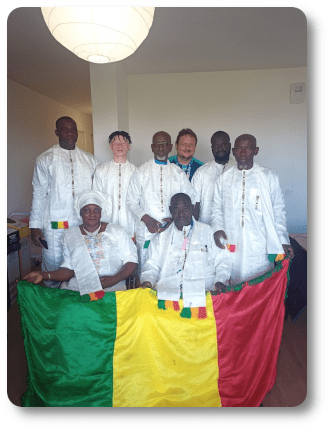
In Mali’s apartment, we discuss the program for the next few days. Friday, Sunday, and Monday promise to be demanding. I am to accompany Amadou to the mission chiefs’ meeting starting at 7 a.m. There are competitions in the morning, and in the evening I will accompany him to various galas. From 7 a.m. to 10 p.m. is long, but since it is only three days and I am grateful for the insight, I gladly agree. The head asks me to accompany him to the village square in the evening so he can watch the opening ceremony. I agree, even though I will again exceed my hours. Anything is better than having nothing to do.
In between, I go to the cafeteria, and when I return to the Mali delegation, they are already preparing for the opening ceremony. I am asked to take photos, and in the end, they insist that I join them—a gesture I did not know from the Bahamas.
After the delegation departs, I invite Amadou to take a walk through the village before watching the ceremony. I offer to take a photo of him at the Paralympics symbol, which he gladly accepts. He has seen nothing of the village except the cafeteria, and since the logo is on the other side, he gets an overview. Shortly before the climb, he signals that he needs the restroom, and I push him into the Olympic Bar. This is also technically off-limits to me, but the staff there are very friendly and offer me free drinks like everyone else. The bar is run by Coca-Cola, a main sponsor. Amadou gets a muffin and a coffee and enjoys them. On the way out, we pass a display with free bananas and chocolate bars. The head cannot resist, and I am reminded of my father, who would not have resisted either.
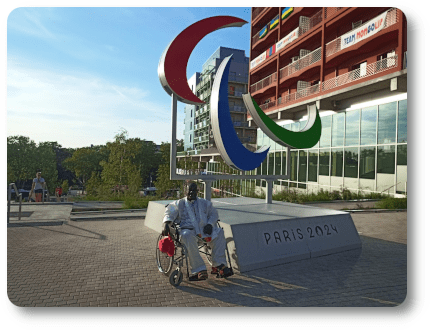 Amadou is heavy, which is why he cannot move the wheelchair himself. Now that I am pushing him up the long zigzag ramp to the Paralympics logo, I notice this especially. He jokes that I will sleep very well that night, but what really gets to me is the heat. Nevertheless, we make it to the top, and after some waiting, we manage to take a photo of Amadou, albeit in poor lighting.
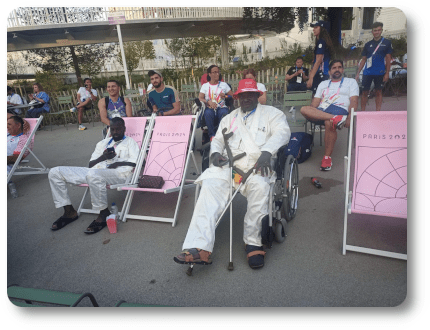
I take a small detour back to the village square and sit down on a folding lounge chair. Within two minutes, a staff member tries to chase me away, as these chairs are not intended for volunteers. Before I can say anything, the head intervenes. After 12 hours in the village, I am tired and increasingly irritated at being pushed around. The woman leaves without a word, but I feel uncomfortable. Another member of the Malian delegation comes by and promises to take Amadou back to the room. I can finally head back to my accommodation. We arrange to meet at 8 a.m. the next morning.
7. Thursday, August 29
As promised, I arrive at 8 a.m. at Mali’s apartment, and shortly after, Amadou appears. We talk about computer science, and I promise to look for good and affordable laptops online, which I have since done. First, however, I want to go to the NPC office to officially switch to Mali. Pakistan has still not responded. During the night, around 11 p.m., an unknown French number called me. Since no message was left, I ignored it.
The NPC office has its usual kindergarten atmosphere. At first, I found it rather charming how the young people interacted. I didn’t want to spoil the mood. But now it is getting annoying that you cannot have a conversation with a staff member without them being distracted by colleagues showing photos, funny posts, or hugging each other. I feel reduced to a nuisance and petitioner. Faustine, along with Lara the only truly professional one, is not there. Now I am told that I was only share-pool for Mali—they already have two volunteers and don’t need a third. The fact that I have not seen them does not matter. It was the opening day. Smiling, they suggest I go to Gambia. After some back and forth, I agree to contact Gambia. Still, I make sure to say goodbye to Amadou, even though the NPC office considers it unnecessary. We promise to stay in touch, and I go, annoyed, to the break room to have a coffee and contact Gambia. WhatsApp shows only a gray checkmark for a long time. Around noon, I finally receive a reply from Hagie, the head of Gambia, saying they are at the stadium but will return soon.
In the meantime, I write a WhatsApp message to Emelie, my colleague from the Olympics, who works at the European Parliament’s press office in Brussels. She writes, among other things:
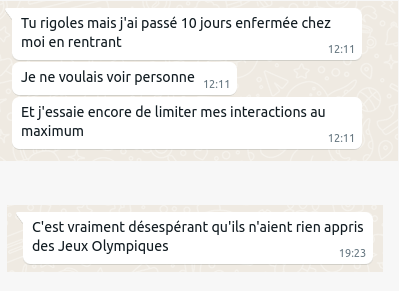 You laugh, but after I returned, I locked myself at home for ten days. I didn’t want to see anyone. And I am still trying to limit my interactions as much as possible.
It is really desperate that they learned nothing from the Olympic Games.
It is 3 p.m., I am still tired from the previous day and already considering leaving when Hagie calls me to his apartment. During the conversation, I also see that Lara from the NPC office has sent me a message. A Felix from the mission chiefs’ office told her that Pakistan has been trying to reach me for days, and I should contact him.
I am already in Gambia’s building but misunderstood the apartment number. I wake up a Ukrainian athlete, who initially looks annoyed but accepts my apology with a smile. I begin to doubt whether it is worth reporting to Gambia if I might be reassigned again the next day. So I call Felix. He reproaches me for not trying hard enough to find the Pakistani delegation. When I try to explain that I was in his office and found no one, he interrupts me rudely and asks if he may speak now. I am allowed to listen, but not speak? For the first time, I raise my voice and tell him to coordinate with Lara. I will respond in ten minutes. “We’ll see,” I reply and hang up.
Half an hour later, it is already 4 p.m., the end of my shift, and I head toward the exit, annoyed. Shortly before the gate, Lara calls me. She actually listens and promises to quickly register me with Gambia. I tell her that Felix should not call me again. I am an adult. I do not expect a red carpet, but at least to be listened to. I notice that the constant reprimands and being chased away are taking a toll, and I am becoming increasingly aggressive. I say I will go eat a pizza to calm down. We chat, even laugh, and I send a WhatsApp message to Gambia that I will be there at 8 a.m. the next morning.
Just before the metro, my phone rings. It is Mahmoud from Pakistan. He is sitting opposite Felix—the one who is not supposed to call me anymore—and asks me to return to the village so he can meet me. He sounds reasonable and friendly, and it is hard to say no. We arrange to meet 45 minutes later at his apartment.
I compare his number with my call list, as Mahmoud insists he has been trying to reach me for days. Indeed, I find two calls from his number on Tuesday night. Since he did not try calling at reasonable hours, leave a voicemail, or send an SMS, I feel uneasy about the Pakistanis. I call Lara again. She laughs and reassures me that I am firmly assigned to Gambia. So I send Mahmoud an SMS saying I am now assigned to Gambia, turn off my phone in frustration, and return to my apartment.
When I turn my phone back on around 8 p.m., I receive a message from Hagie that the NPC office has sent another volunteer named Moritz, and he is now with them. I am no longer needed.
That was the moment I decided to call it quits.
Friday, August 8
In the evening, I wrote Lara on WebEx to inform her of what had happened. The next morning, I follow up, telling her I will vacate my room and go home. I would not endure another day in the break room or another reprimand from staff.
A surprisingly pleasant chat develops, during which Lara even apologizes and says she regrets that I had a bad experience in the village.
I reply that although I am disappointed, I leave with a smile. After all, I had the chance to meet wonderful people from all over the world, from different religions and backgrounds. She even thanked me for my smile.
Afterword.
The head of the Malian delegation just called me and asked how I am doing. It could all have turned out so well...