 Paris around noon. I’m standing in a long line. The distribution of the Olympic uniforms for volunteers has begun. I’m surprised at how long the line is. After all, precise time slots were assigned. Nevertheless, an estimated 400 people have gathered in front of the entrance to an exhibition hall in the south of Paris on Avenue Ernest Renan.
There is dead silence in the line. I wonder if it has anything to do with the jury’s verdict in the Trump case, and I can’t help but grin with joy.
The first 100 people are let in, and it takes a good 30 minutes before the second group of 100 is allowed to enter the hall. Once again, I find myself in a line, this time structured like an airport. As soon as a counter becomes free, you’re waved over.
A man around my age, speaking broken French, receives me. He takes down my details and compares them with the data on hand, attempting a joke that I politely smile away. As a farewell, he hands me two cards for regional transport, so I can travel for free during the Games.
On to the next counter: Again, I’m in a line, but this time it’s only a handful of people. I take the opportunity to chat with a man next to me. I’ve been wondering whether the Navigo card for transport is also valid for the period I’m assigned to work, which is before or after the actual Games. After all, my assignment starts a week before the opening ceremony. He quickly finds the relevant text on the card and can answer my question with a "Yes."
Soon, my first name is called, and a lady—this time of Asian appearance, again speaking broken French—hands me my Olympic ID with a big smile.
Together with the nice man, we make our way to the uniform distribution station, about 800 meters away. Again, a short line. This time, I’m greeted by a friendly young lady with no accent but unclear pronunciation. This time, it gets really difficult, and I’m sorry I have to lean so close to her. I just want to understand what she’s saying to me.
Before trying on the uniform, we have a coffee together. He tells me about his mission: securing the race track for the cyclists. Only in the changing cabins do our paths separate.
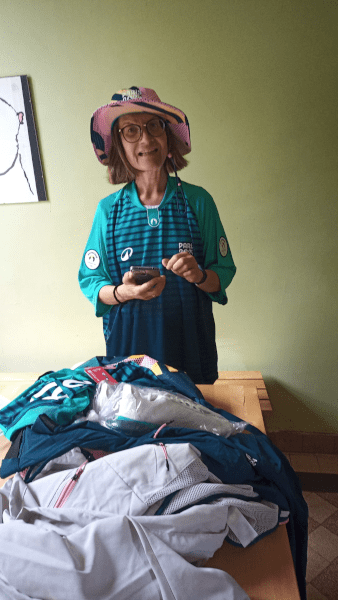
With a sheet in hand, on which the sizes of the individual clothing items are marked, we are supposed to check off the sizes that fit us. After that, we proceed to the clothing distribution. So far, so unspectacular.
Once I get home, my wife takes my bag with the uniform to show it to her students. For the first time, I take my ID in my hand and see what’s written on it: access to all sports venues, access to the international broadcasting center, access to the press center, access to the Olympic Village and residential blocks, access to the athletes’ transport system—jackpot!