Friday, December 1st, 2023, at Puiseaux Town Hall, Room 10.
There are three sessions before the performance of "Once Upon a Time in Puiseaux," three rehearsals on three Fridays before the town center is closed on Saturday, December 16th, and our curtains rise. It is almost 6:00 PM, and we still don’t know which roles we have been assigned.
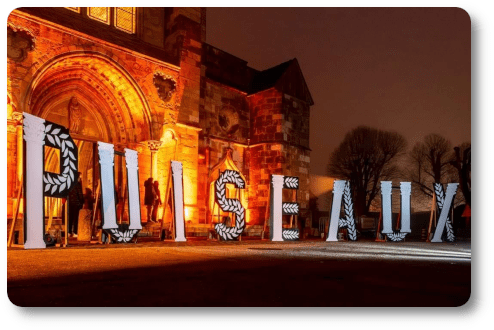
It’s as busy as a dovecote, even though the meeting has officially started. People are trickling in and greeting each other warmly—after all, they haven’t seen each other for a year. At the same time, Stephanie is trying to explain this year’s theme and the individual scenes to us. The fact that her colleagues from the theater keep arriving and she has to start over again doesn’t seem to bother her. She knows that once people are divided into their roles, the chaos will sort itself out. A colorful bunch, these actors. The lady with whom I once sang the Belgian national anthem is now a man. None of the professional actors have a fully coordinated outfit—some detail always stands out. In short: I like these actors and the people who participate every year. To my right sits Michel, the former mayor of Puiseaux, who greeted me with a high five. To my left sits Yannick, whose wife I played a Cossack with last year, but who is now facing surgery and will be in the hospital on the day of the performance. Yannick greeted me with a hug. We are briefly told our roles and locations, and then it’s off to the first rehearsal. The most elaborate performance is to be staged in front of the town hall. It’s about the "Lendit," the French counterpart to the German Federal Youth Games, though spiced with French-patriotic pomp, which is why this annual event was gradually abolished in the eighties. But the older generation fondly remembers the Lendit. In the seventies, the "Intervilles" games were also very popular in France, where municipalities competed against each other in unusual disciplines, and the TV show "Jeux Sans Frontières" (It’s a Knockout) emerged from them. Henry IV, who often passed through Puiseaux, had a tennis court built in Fontainebleau. Reason enough to dedicate a sketch to him as well.
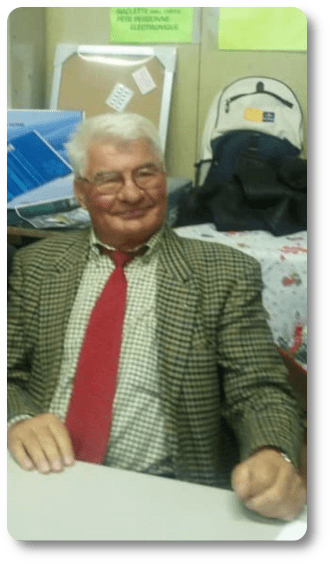
My scene is to be performed in the church. Although this is the seventh time I’ve participated in this event, I’ve never performed in the church itself. Everyone else in my group has, and the old building has a bad reputation among the actors. Too cold and a fierce draft that whistles through the nave of the church to torment us in the transept, where we will mainly perform. Together with Saskia, who will lead our rehearsals, we are seven: two teenagers of thirteen, whom I initially take for older, two women in their forties, the town optician, and me. Saskia hands us a form to sign for insurance reasons, making us members of the theater association, and vaguely explains the scene. Raymond Poulidor, a successful cyclist who never won the Tour de France and was known as the sympathetic runner-up, visited Puiseaux in 2010 as part of a bicycle fair. Poulidor, played by Daniel the optician, who actually looks like the now-deceased original, arrives, gives autographs, and leaves. Short and simple.
 |
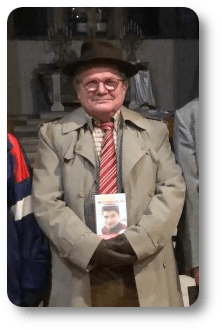 |
| Raymond Poulidor 2010 in Puiseaux | Our "Poupou" |
In the following week, Saskia lays out costumes in the church. Since our short scene is set almost in the present, the costumes are not elaborate. The scene itself, however, becomes complex, as the theater director will spend most of the time with us during the next two rehearsals. Since the audience can observe us from three sides and we should neither block their view nor turn our backs to them, our performance turns out to be more complicated than expected. I get the role of the organizer who welcomes Poulidor, organizes the fans, gives an interview, and bids farewell to Raymond at the end. By now, I’d almost prefer a short text, as the brief scene has become quite extensive, and I even break a sweat during rehearsals.
The day of the performance unfolds as it has in previous years: getting made up, final preparations in the scene, and lots of talking to calm everyone’s nerves. Leticia, one of the amateur actors in my group, had scolded me the day before. I had held the door open for her with the words "Ladies first," and she found the role model outdated. I had only known such reactions from Germany. Now it’s Leticia who is doing my makeup, and she has cake and mulled wine in her bag. I spare myself an awkward comment about outdated role models. Leticia studied psychology and knows what she’s talking about, and the mulled wine might still come in handy.
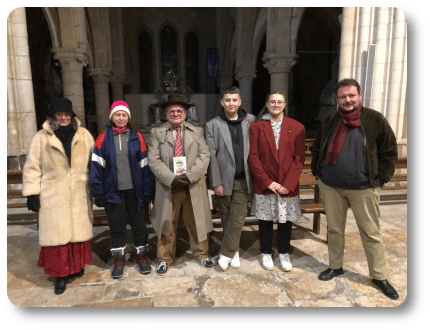
It’s just before the performance. Although the town center is still closed to the audience, there are already guests in the church watching us. Uncomfortable minutes. Just before the official start at 5:30 PM, Saskia sends Danny on the first round.
We are lucky: It’s cool, but foggy, which benefits the outdoor light installations and means there’s no wind. As a result, there’s no damp, cold draft in the church, and the 300 candles in the glasses placed around us bring the temperature to a bearable level.
I move toward the table, adjust books, a pen, and a notepad, when Poulidor’s bicycle bell rings, signaling the start of the first round. Saskia starts to stress about where the guest of honor is. I also walk across the stage annoyed and talk to Leticia. This will be the moment when I take my first sip of mulled wine. Since I rarely drink, my performance will become more expressive as the alcohol level rises during the evening. Poulidor has almost arrived, and I open an imaginary door, greet him effusively, place his bicycle in a pew, and guide him to his table. While he inspects the prepared setup, I fetch a cushion for the guest, shake it out, place it on the chair, and help the elderly gentleman sit down. After massaging Poulidor, forcing him into a selfie with my old flip phone, and giving him a firm pat on the shoulder, I call the first fan, played by Leticia. Now Saskia comes to me and interviews me. Without words, I report on his arrival and his sporting achievements, emphasizing "second place." Meanwhile, I notice that Sandrine is bothering Poulidor with special requests for too long. I phantom-scold her and wave our young actors over. Since they introduce themselves to the guest of honor by name for a signature in a book, I have fun whispering different German first names to them each time and mischievously enjoy their pronunciation. Now I organize three group photos, each in the direction where the audience is standing, thank our guest of honor again, accompany him outside, while the other actors twirl around with their books in joy. I put the cushion away, stack the books, and tidy up the table until the bicycle bell rings and everything starts again. About thirty times that evening, until the church bells signal the end.
 We continue to perform until the orchestra comes into the church to pick us up, as they did earlier with the other actors. Together, we move to the square in front of the church and celebrate the closing ceremony.
Slightly tipsy, I am asked that evening if I will be there again next year, and knowing that I will have a cold next week, my answer remains vague. But if I receive an email from the theater next November, I will certainly say yes again. Culture and history are things that define us as a society, and I find it beautiful and enriching to celebrate our values on this evening and to look beyond the horizon.
This is the continuation of the text: The Theater Before the Games.
Here is the link to the photo gallery:
The images are published with the kind permission of THÉÂTRE DES MINUITS.