 Shortly after Viktor Orbán's electoral defeat, EU Commission President Ursula von der Leyen called for an end to mandatory unanimity in the EU's foreign policy. At a conference in Brussels on April 13, she urged member states to seize the opportunity to switch to the principle of majority voting.
The EU wants to move away from a model where one country can block 26 others for months, toward a model where 15 countries can agree and a decision can be reached quickly. If successful, this will be a geopolitical gamechanger. Faster decision-making, a unified foreign policy, and reduced vulnerability to blackmail by individual members would be the result.
The EU's Main Problem
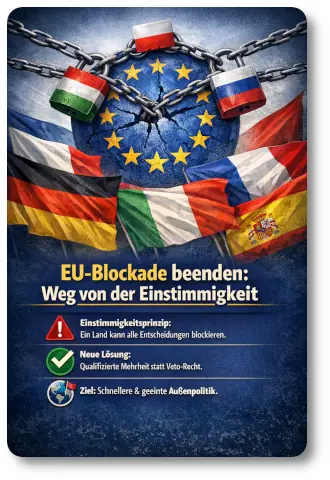
Currently, EU decisions on foreign policy, sanctions, or enlargement require unanimity among all 27 member states. A single country can block everyone else.
Between 2016 and 2022, member states used their veto at least 30 times regarding foreign and security policy decisions—and those are only the publicly documented cases. Informal vetoes and backroom deals likely increase that number significantly.
Hungary alone accounted for 19 of the 46 EU vetoes from 2011 to 2025—more than double that of the next highest member state.
Orbán blocked, among other things:
- the 90-billion-euro loan for Ukraine
- the 20th sanctions package against Russia
- the acceleration of EU accession negotiations for Ukraine
- as well as regularly sharing internal EU discussions with Moscow
For over a year, the EU could not reach a joint statement of support for Ukraine because Orbán refused to cooperate.
The Veto as Political Leverage
The use of the veto increasingly devolved into a political lever for unrelated goals:
- Unlocking EU funds
- Mobilizing domestic voters
- Forcing concessions that had nothing to do with the actual decision
The Proposal: Qualified Majority
Von der Leyen's proposal aims to transition to Qualified Majority Voting (QMV).
Under this system, it would be sufficient if 15 member states agree—provided they represent 65% of the EU population.
The Passerelle Clause
The mechanism already exists: the so-called Passerelle Clause, introduced in 2009. It allows the EU to change voting rules without completely rewriting the treaties.
The catch: activating it also requires unanimity. All 27 states must agree to end the requirement for everyone to agree.
Consequently, the clause has never been used—last blocked by an Orbán veto in 2018.
New Political Landscape
With the change of power in Hungary, this could change. Péter Magyar won the election decisively and announced his intention to lead Hungary back into the European family.
Like von der Leyen, he belongs to the Christian Democratic political family. His third official visit abroad will be to Brussels.
Von der Leyen reacted swiftly to this new situation. Her choice of words ("momentum") underscores the urgency—the window of opportunity could close quickly.
Why QMV Would Be a Gamechanger
The 90-billion-euro loan to Ukraine, blocked since December 2025, could be released promptly once the veto is lifted and QMV applies.
Sanctions packages against Russia, which previously took months, could be decided within days—without having to grant political gifts to blockers.
In the past, individual states have already blocked EU declarations:
- Greece and Hungary prevented statements regarding China in 2017 and 2021
Under QMV, such blockages could be overridden as long as enough states agree.
Support is Growing
A support group for the expansion of QMV already includes 12 member states, including:
- Germany
- France
- Italy
- Belgium
- Luxembourg
- Netherlands
- Romania
- Slovenia
- Spain
This puts the group just short of the necessary threshold of 15 states.
Orbán's departure could decisively change the political calculation for those who remain undecided.